
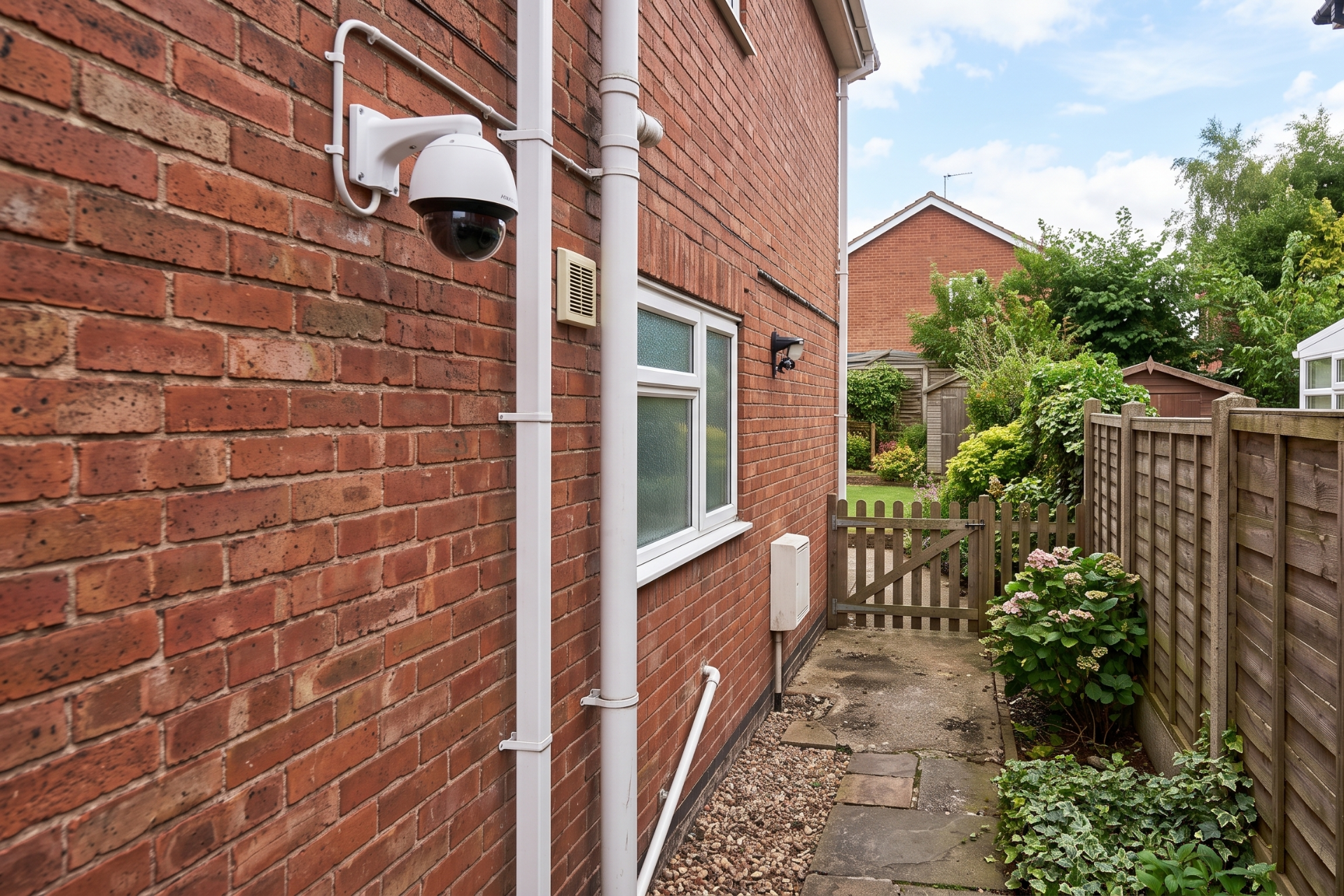
You could argue that anyone can screw a camera above a front door, but effective home security requires a much more strategic approach. It’s not just about having cameras on your property. It’s about exactly where those lenses are pointing. Professional security installers design residential CCTV layouts based on common intruder entry routes and property geometry to maximise coverage.
When considering upgrading your home’s defences, the importance of strategic residential CCTV camera placement cannot be overstated. Even the highest quality of camera is essentially useless if poorly placed, whereas a well-placed system serves as both a powerful deterrent and a reliable witness.
Key Takeaways for Effective CCTV Placement:
- Target primary choke points: driveways, side alleys, and rear access doors.
- Mount cameras at an optimal height of 8-10 feet to capture facial details.
- Avoid placing cameras facing direct sunlight or too close to walls to prevent infrared (IR) glare.
- Professional installation eliminates blind spots that single wide-angle DIY kits miss.
Securing the Choke Points: The Psychology of a Burglar
To build an effective perimeter security system, you have to think like someone trying to breach it. Opportunistic burglars always look for the path of least resistance, seeking shadows and blind spots. Because of this, your residential CCTV system must proactively monitor your property’s primary choke points; the areas where an intruder is forced to pass through.
- Driveways and paths: This is the most common point of entry for vehicles and for criminals scoping out targets. A strategically placed camera here can capture number plates and clear facial shots before an intruder even reaches your porch.
- Side alleys and gates: Narrow side passages are a burglar’s best friend, offering excellent concealment from street traffic and neighbours. Covering these tight pathways ensures anyone attempting to slip into your back garden is immediately detected and recorded.
- Rear access points: Back doors, conservatories, and ground-floor windows are prime targets for forced entry. Overlapping camera fields of view in these vulnerable areas leaves a trespasser with no hiding place.
Common DIY CCTV Installation Mistakes
The rise of off-the-shelf, plug-and-play security kits has led to an epidemic of poor CCTV camera placement. Whilst installing it yourself might seem cost-effective, amateurs frequently make critical errors that compromise their home’s security:
- Mounting too high: Placing cameras under the second-story eaves might protect the hardware from vandalism, but the extreme downward angle usually only captures the tops of people’s heads, making facial identification impossible.
- The industry standard height for mounting residential cameras is between 8 and 10 feet. This prevents vandalism while maintaining a shallow enough angle for clear facial recognition.
- Ignoring lighting and glare: Pointing a lens directly at where the sun rises, or too close to a bright security light, will wash out the image. Similarly, placing cameras too close to walls can cause the camera’s own infrared (IR) night vision to reflect back into the lens, blinding the camera at night.
- Avoid pointing cameras within 50 degrees of the rising or setting sun to prevent sensor wash-out.
- Underestimating blind spots: A single wide-angle lens rarely covers an entire garden. Amateurs often leave massive blind spots that a professional would easily eliminate with a tailored, multi-camera layout.
- Neglecting foliage: A camera view that looks clear in winter can quickly become entirely obstructed by leaves and branches by mid-summer.
Why Should You Call in Professional Residential CCTV Installers?
Creating full coverage requires precision engineering. Security experts don’t just glance at a house; they evaluate its unique geometry, natural lighting changes, and environmental obstacles. They match the right lens focal length to the correct zone, ensuring that your system provides actionable footage rather than a blurry, distant shadow. Professional installation also ensures tamper-proof wiring, reliable power supplies, and optimal viewing angles that DIY jobs simply cannot guarantee.
Investing in top-tier hardware is only half the battle; expert residential CCTV camera placement is what actually protects your home, your assets, and your family. Don’t leave your perimeter security to guesswork or vulnerable DIY mounting techniques.
If you are looking to upgrade your home’s protection with a system designed by professionals, trust the experts to secure your property. Learn more about our professional CCTV installation in Southampton and let First Contact Fire & Security build an inescapable net around your home today.


02380 410 61002392 550 627
[email protected]